
Common plumbing problems in Downtown Escondido historic homes
Layered original pipe, shared stacks, and hard-water wear explain most Downtown Escondido historic-home plumbing problems. Here is how to read the symptoms.
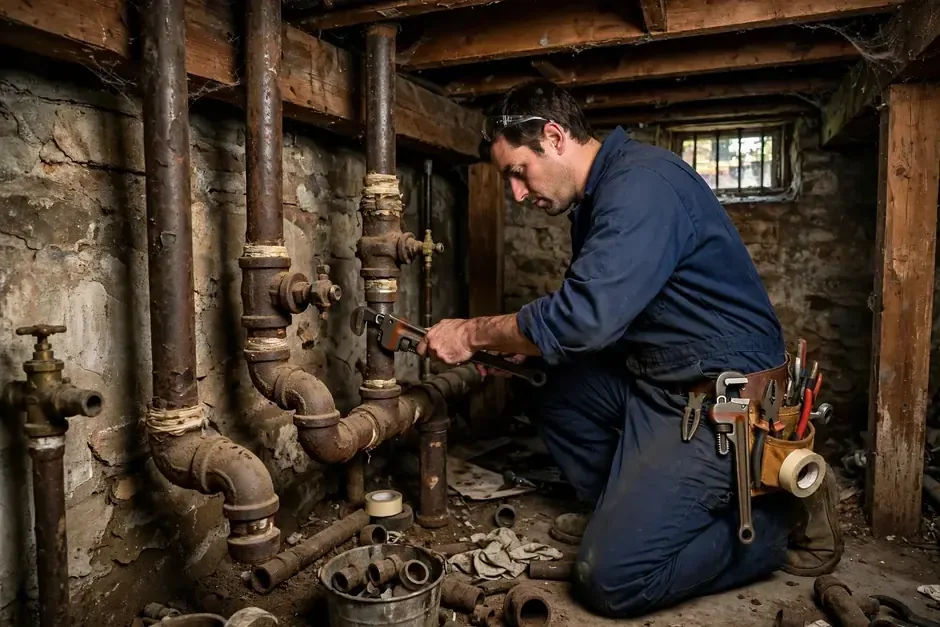
Downtown Escondido historic homes share a plumbing story that newer subdivisions do not: pipe laid down in different decades, mixed-use stacks where they exist, and Escondido hard water working on every seal and valve. The problems below come up again and again in the downtown core and the Downtown Escondido area, and each one reads differently once the house's history is part of the diagnosis.
Layered original pipe is the first problem
A house built in the early 1900s and updated in the 1950s and again later may carry galvanized supply, cast-iron drains, and copper retrofits all at once. That layering is why a single symptom can mislead: low pressure at several fixtures points to supply-line condition, while one slow drain points to a local blockage. The working rule in these homes is map before you cut. A camera pass and tracing show what is actually in the walls, so the repair plan is built on the house, not on its build decade. For a full-system question, see whole-house repiping in Escondido and how a repipe is scoped room by room.
Shared stacks change a backup
Where a downtown building mixes shops below and homes above, a backup in one unit may start in a shared stack. Clearing only the unit that called will not hold if the source sits further along the line. The useful first facts are whether neighbouring units are affected and whether the problem follows a pattern after heavy use. Tracing the shared line, with the building owner coordinating shut-offs, is what separates a repeat call from a repair.
Hard water wears rubber and valves
Escondido water is hard to very hard. The City of Escondido 2025 Water Quality Report gives hardness of 210 to 230 milligrams per litre, averaging 215, for City-served customers, and that figure applies to City customers only. Rincon del Diablo customers should check their own provider's report, since the City figure is not theirs. Hard water leaves scale in heaters and on valve seats, pits flush-valve seats so flappers cannot seal, and shortens the working life of rubber parts. Spotted dishes, soap scum, and a heater that rumbles are the household signs, and regular flushing and descaling, following the maker's guidance for the model, are the maintenance answer.
Small spaces and tight access
Historic homes and downtown lots are tight: small utility closets, crawl spaces, and on-street parking. A water heater that fits a newer garage may not fit a historic closet, and a softener or manifold needs a spot where it can still be serviced. Planning the replacement around the space, rather than ordering first and measuring later, prevents the most common historic-home frustration.
When to call, and what to say
Call when several fixtures lose pressure together, when a backup returns after clearing, when a slab floor shows a warm or damp patch, or when a shared-stack problem touches more than one unit. When you call, note the house's rough era, whether other units are affected, and what changed first. For sewer-specific symptoms, sewer line cleaning in Escondido explains the camera-check step. The neighbouring Old Escondido Historic District page covers the residential district just south of downtown, where exterior-visible work also carries a Certificate of Appropriateness check.
Frequently Asked Questions
Why do Downtown Escondido historic homes keep having plumbing problems?
Because the pipe itself is layered across decades, the buildings often share stacks, and hard water wears seals and valves. Diagnosis starts from the house's history and is confirmed by inspection, not by the symptom alone.
Is low pressure at several fixtures a supply-line problem?
Often, yes. Pressure loss across the house points to supply lines, while pressure loss at one tap points to that fixture. A plumber can confirm which it is before any replacement is planned.
What should I do about a backup that affects a neighbouring unit?
Note which units are affected and stop using water in the affected units if you can. A shared stack or lateral is the likely source, and tracing it with the building owner is the next step.
Does Escondido hard water really damage plumbing?
Hard to very hard water leaves scale and wears rubber parts and valve seats over time. The City's 2025 report figure of 210 to 230 milligrams per litre, averaging 215, applies to City-served customers only; Rincon customers should check their own provider's report.
Should I repipe or keep repairing?
That depends on the pattern: isolated failures suit repair, while recurring small leaks and house-wide pressure loss point toward a repipe conversation. A camera and tracing pass gives the evidence for that decision.